
TLDR
- The way Doogs Studios Sherman tracks go together is changing
- Printed track sets will ship exclusively with a new, full-width track pin approach.
- Press-fit connectors will continue to be available in STL format, and will work with current and future Sherman track sets
- This shift is being driven by a key guiding principle here at Doogs Studios: go-togetherness
When it comes to track design, Sherman VVSS tracks aren’t the biggest pains in the ass, but they’re a far cry from the standard two links, one pin approach you’d find on, say, a T-34 or Panzer III. The separate track links and end connectors have given kit and aftermarket producers trouble since forever.
I’ve built most of the available options and to be honest, that’s what drove me to tackle 1/16 Sherman tracks back in early 2024. Most of the options are varying degrees of painful.
In 1/16, I ultimately landed on a full-width track pin with press-fit end connectors. My track experience up to that point had been of the two links, one pin variety, and I’d tackled those with press-fit track pins, so it seemed logical to carry that on. In 1/16, the large pin diameters made the press-fit design relatively forgiving, and if the pin ridges didn’t click in, you could always just glue them.

When I embarked on 1/35ing the tracks, I found that the same approach flat-out would not work. The pins and end connectors were just too delicate, and the tolerances just too tight. Pins would break. Or end connectors would crack trying to seat the pins.
Ultimately, I solved things by inverting them and placing the track pins on the end connectors.

When these work, they work great. Especially combined with the assembly jig and end connector holder.
When they don’t work, though, they can absolutely fuck you. If you accidentally snap a pin, you don’t just lose that end connector – the link is toast, too. And replacing the link can be a tall order if it’s connected to a chain of a bunch of other links.
All that is totally manageable if you’re printing STLs and have multiple diameters of track pins to play with. But that’s not possible with a printed set.
Anagnorisis
The drawbacks of the press-fit end connectors leapt out when I was shooting an assembly video. I was trying to stick with a single pin diameter, but again, the tolerances are so tight in 1/35 that the connectors would work their way loose in some links, and be so tight in others that the tracks wouldn’t really move if I got the pins driven all the way in.
That’s not the level of go-togetherness I want a customer to be experiencing.

Revisiting Full-Width Pins
Between the Sherman tracks and the struggles dialing in the even smaller 1/35 Stuart tracks, I had to come up with some kind of alternate system that would:
- Be more forgiving from a tolerance standpoint
- Be more robust, particularly to handling and installing onto the suspension
- Fulfill my mission of go-togetherness
That meant giving up on press-fit pins.
Part of the aversion to glue and tracks is that it’s rarely done well, particularly with Sherman tracks. Again, they’re a pain in the ass track design.
But if you can figure out a way to fix the track pins and end connectors, you can also get a supremely workable set of tracks.
My Silly Pins
I started in the most challenging situation – those teensy 1/35 Stuart tracks. It became apparent right away that I wouldn’t be able to bore two round holes into each end connector and shove some slightly smaller diameter pins into them.
We’re operating at ant fart levels of tiny here. A round pin in a round hole doesn’t have a lot of bite, and can easily work its way loose. But a “D” shape? That provides a brake against those rotational forces and works rather well.
To make alignment easier, I also cut two channels in the main pin body, one at the top and one at the bottom. These can even hold a pin wash to make them more visible.
For the Sherman, I had more (a little bit) more room to work with, so I got slightly fancier with the pin and socket design. Basically I wanted more contact points where glue could do its thing, even something like Ammo Ultra Glue or another sturdy PVA. And I ended up here:

The Power of Systems
Over the years, I’ve become a big fan of the value of systems and platforms. And not in the bullshit B2B SaaS salesspeak kind of way. But in the rings of design choices, peripherals, and support mechanisms that make a thing truly shine.
For example, I love the Hoopat resin vats and their quick-change FEP system. It makes a significant pain point of 3D printing a virtual non-issue. That’s a system, from the vats themselves to the specifically-cut FEP sheets, to how they integrate with the printers they’re designed for.
With tracks, it’s the mechanisms that make assembly less of a fiddly nightmare. It’s designs that allow you to test fit easily and install and remove tracks until you’re ready to lock them in.
That’s why Doogs Studios Sherman track sets include three build aids to make your life easier.
First, there’s an end connector block that allows you to place a row of end connectors and install track pins. No more parts flinging off tweezers. No more wondering where to put the damn things while the glue sets up.
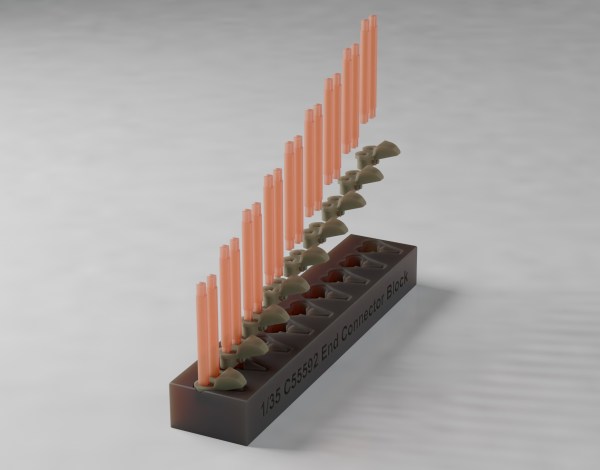
Next, there’s a track jig that lets you quickly line up 10 links. The end connector block spacing matches the track jig, so if you want you can thread a whole side at a time. In my experience, getting so many track pins lined up exactly is a bit much, and it’s easier to just grab one at a time with tweezers.
And finally, there’s a single end connector holder that’s supremely useful for installing the far run of end connectors onto the track pins where they emerge from the tracks.

I’m shooting assembly footage now and, at least for me and how I prefer to work, I definitely prefer the full-width pins. They do lack the satisfying click of a pin seating properly, but they are much more stable once they’re together, and they are among the most workable tracks I’ve ever put together.
Where You Can Get The New Pins
The new pin connection system will be launching with the upcoming T51 tracks, and will be a part of every printed track set release.
The physical duckbill sets will also be rolling over to this new system.
Digital sets like the T54E1 and T49 will be updated shortly as well.
What If You Really Prefer Press-Fit Pins?
Press-fit end connectors will continue to be available as part of existing digital track sets, and I will be making them a special order print product as well. Meaning – I won’t actively be stocking an inventory of them, but can print them out easy enough as orders come in.
Looking forward to these. Full pins have always been my preference due to the very situations you described with short ones.
I am holding off on a Sherman project to see how this all pans out.
Brett G
Watching waiting and hoping this all goes to plan.